|
| India has a centuries old tradition of dyeing textiles. Manjistha-dyed cotton fibres were found in
Mohenjo-Daro, indicating that Indians had mastered the difficult and complex art of dyeing cotton by the second millennium B.C. |
Traditional materials:The traditional Indian dyer used myrobalan, alum, wood ash and dye extracts to colour textiles. These ancient processes have been documented by the British and published in 19th century monographs. We have studied them and updated the process using myrobalan, alum, soda ash and dye extracts. Most importantly we have experimented and learnt that the yellow, brown and earth colours from leaves can be used instead of flowers, roots and barks, and are far better suited to sustainable collection.
In our process, the leaf colours are light fast as the leaves are continuously exposed to the sun. For the first time we have obtained an entire range of natural colours which are light fast. We do not use chromium or synthetic alizarin to obtain our fast shades. For indigo too we do not use the highly caustic hydrosulphite process as it cannot be completely washed out of the fabric and leaches out onto the wearer’s skin. We use the traditional fermentation method as practiced for centuries to give a colourful and safe product. All our dye sources share a common heritage as ingredients in ayurvedic medicine.
()

|
Early texts: There are many references to dyeing in early Indian texts, possibly the earliest being in the Arthasastra of Kautiliya (Mauryan period, 3rd century B.C.), which refers to dyeing using nila, puspha, lac and manjistha (Section 76).
Colours were specified for the different castes in The Gautama, a Hindu law code of 3rd – mid 2nd century B.C., which states that garments may be dyed with tree resin (brown) for a Brahmin, manjistha (red) for a Ksatriya and turmeric (yellow) for a Vaisya. In times of adversity a Brahmin may not trade in garments dyed red, and a ‘Bhat’ graduate should not wear clothes dyed red.
The use of indigo-dyed fabric is mentioned in the Angirasa Smriti, a Brahmanical text of ca. 6th to 9th centuries A.D. This originally appeared much earlier, in the Apastamba Dharmasutra (VI.1-10) of the 3rd to early 2nd century B.C. It states:
“There is no harm in contacting it while sporting with ladies or while in bed. Possessing such clothing, selling it or making that as his means of subsistence - these three ruin a learned Brahmin and the krichchra vow is prescribed his reparation.
"Bathing, donating, muttering, fire-worship, Vedic recitations, oblations to the deceased ancestors and performing glorious sacrifices-all are fruitless for a Brahmin who wears clothes dyed with indigo. "
"If however he wears clothing dyed with indigo inadvertently, he is freed from the sin by abstaining from food for a day and a night followed by consuming panchagavya”.
|
Indigo (blue): Indigo is recognised all over the world as the most successful source of blue dye. BioDye uses Indigofera tinctoria, a species native to India. A leguminous plant, it acts as a nitrogen-fixative for the soil and has traditionally been used as a green manure by farmers. It is an ideal rotation crop for organic farmers. By extracting the dye from the leaves through a steeping, oxidation and settling process, the spent plant and steep water can be returned to the soil to fertilize it. The land does not suffer and the farmer earns extra income. In the 19th century, British indigo farmers planted it continuously, year after year, using the biomass that remained after extracting the dye to fire their boilers, instead of returning it to the soil. As a result, the soil became chronically short of phosphate so that this excellent plant gained a most unfair reputation for ruining land.
Manjistha (scarlet): this fast dye is the Indian species of the Rubia genus (madder) that is found in many parts of the world. A climber that needs shade, it grows wild in forest areas at around 1000 m and was once so plentiful in India that there is no record of its having been cultivated here. The dye was traditionally extracted from the roots and stems, which meant uprooting the plant and has led in recent times to decimation of the wild sources. To ensure sustainable use of the plant, BioDye has initiated cultivation programmes and uses only twigs and runners for dye. This allows for easy regeneration of the plants. Madder, both Indian and European, is the original source of dye for the ubiquitous ‘red tape’ of government office files.
Helu (yellow): the leaves of the Helu (Meyna laxiflora) shrub give an excellent fast yellow that can be cultivated on waste or marginal land and sustainably harvested. It is not a traditional source of Indian dye but has been developed locally by BioDye in Sawantwadi.
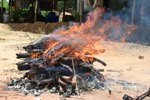
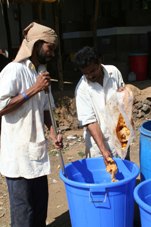
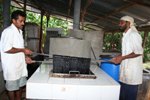
Kasimi-Ferrous acetate (black) the traditional black dye of India is made from iron scrap which is first fired and then fermented with jaggery or old gur. Kasimi gives a rich black; unlike its synthetic dyeing substitute, ferrous sulphate, it does not weaken yarn or fabric. |
 |
 |
 |
| Firing the scrap iron |
Dissolving the gur in water |
Dyeing yarn with kasimi |
|
|
Lac (crimson): lac gives a bluish red dye and, in lower concentrations, pink tints. It is a waste product purified from the effluent of shellac manufacture. One of the dyes mentioned in the Arthasastra of Kautilya of the 3rd century B.C., lac has been used as a cosmetic and as a wool and silk dye in India for thousands of years. According to the Indian Institute of Natural Resins & Gums, lac can be considered a vegetarian product akin to milk and honey. |
|
The crimson lac dye and shellac resin are secreted by female insects of different species, the most important of which is Kerria lacca. A brood of females (who are born and remain wingless and have rudimentary legs), are placed by tribal forest dwellers on tender shoots of trees like Butea monosperma (Palas), Zizyphus mauritanea (Ber) and Schleichera oleosa (Kusum). The females are immobile and are fertilized by the winged male in situ, ending his life cycle. The females lay their eggs and secrete a red resinous cocoon in which to incubate them. Adjacent cocoons merge to coat the twig. In India, where the cocoons are primarily harvested for resin, they are collected after the progeny (nymphs) have emerged and moved out, and the mother, her normal life cycle completed, has died in the cocoon. |
The harvested resin is washed extensively to remove extraneous matter and the red chromogen. For dye production the effluent stream is concentrated, the colourant precipitated out of it and further purified to yield commercial dye.
|
|
|
References:
Kangle RP (1960; 2nd ed. 1969 & 1972) The Kautilya Arthasastra. 2 vols. University of Bombay Studies in Sanskrit, Prakrit and Pali, No. 1. Bombay: University of Bombay, Vol. I pp 129-130; Vol. II pp 254-256
Dharmasutras (2000) The Law Codes of Apastamba [VI.1-10], Gautama [1.19-21, p 121, 7.10, p 137, 9.4, p 139], Baudhayana, and Vasistha. Ann. & tr. Patrick Olivelle. Delhi: Motilal Banarsidass, pp 29, 121, 137, 139, 281, 359, 395
Kane MMPV (1930-1975) History of Dharmasastra. 5 vols. Government Oriental Series Class B, No. 6. Poona: Bhandarkar Oriental Research Institute, vol. II, pt. I, p xii
Banerjei NN (1896) Monograph on Dyes and Dyeing in Bengal. Calcutta: Bengal Secretariat Press, p 35
Fawcett CGH (1896) A Monograph of Dyes and Dyeing in the Bombay Presidency. Bombay: Government Central Press, p 4
(Lac)
|
|
 |
|